Beginner guide · no equipment

12 best exercises for beginners at home (no equipment)

Starting is the hardest part, and most beginner lists give you too many moves. These are the 12 we teach first inside Vigorous Home. Together they train every major muscle, need only a chair, a wall and some floor, and each one has an easier version for day one.

Learn them once and you can build almost any home workout.

Free account and first workout. No card needed.

The short answer

  • Legs: bodyweight squat, reverse lunge, wall sit and calf raise.
  • Upper body: incline chair push-up, then knee push-up when that gets easy.
  • Core and back: forearm plank, dead bug and superman.
  • Glutes: glute bridge — the safest first move for almost everyone.
  • Warm-up and recovery: march in place and cat-cow.
  • Start with 2–3 sessions a week, and add 1–2 reps per set each week.

The 12 moves, step by step

Each picture shows the start and finish position. Move slowly: two seconds down, one second up.

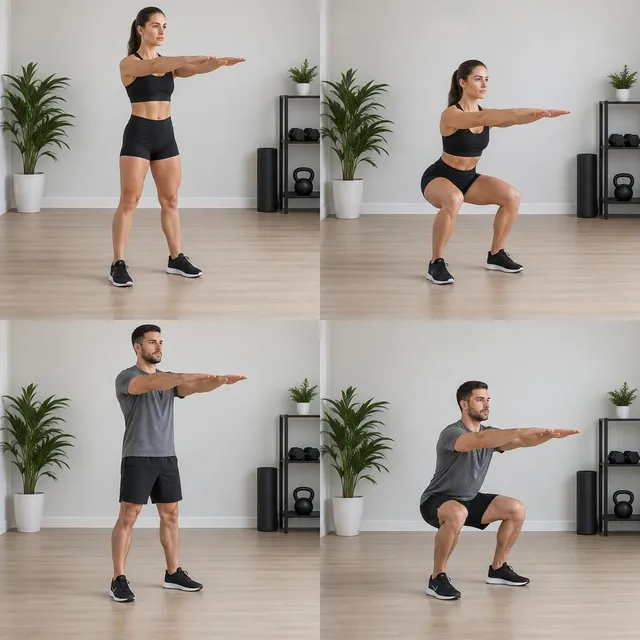
Bodyweight squat: start and finish position, shown by a woman (top) and a man (bottom)

1.Bodyweight squat

Works
Thighs, glutes, core
Beginner dose
3 × 10
  1. Stand tall, feet shoulder-width apart, toes slightly out.
  2. Push your hips back and bend your knees as if sitting into a chair.
  3. Lower until thighs are roughly parallel to the floor, chest up.
  4. Drive through your heels to stand back up and squeeze your glutes.

Too hard? Sit back onto a chair and stand up again.
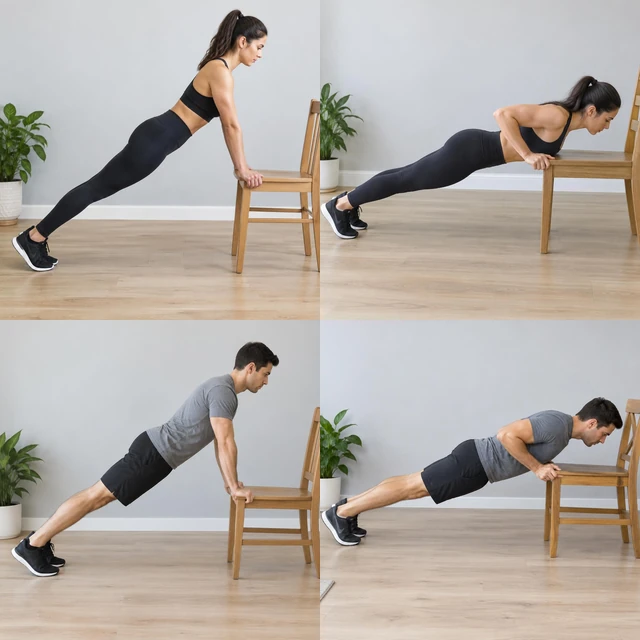
Incline chair push-up: start and finish position, shown by a woman (top) and a man (bottom)

2.Incline chair push-up

Works
Chest, shoulders, arms
Beginner dose
3 × 8
  1. Place hands on a sturdy bench, step or wall, slightly wider than shoulders.
  2. Walk feet back so your body is a straight line from head to heels.
  3. Lower your chest toward the surface with elbows tucked.
  4. Press back up to full arm extension.

Too hard? Use a kitchen counter or a wall — the higher the hands, the easier it gets.

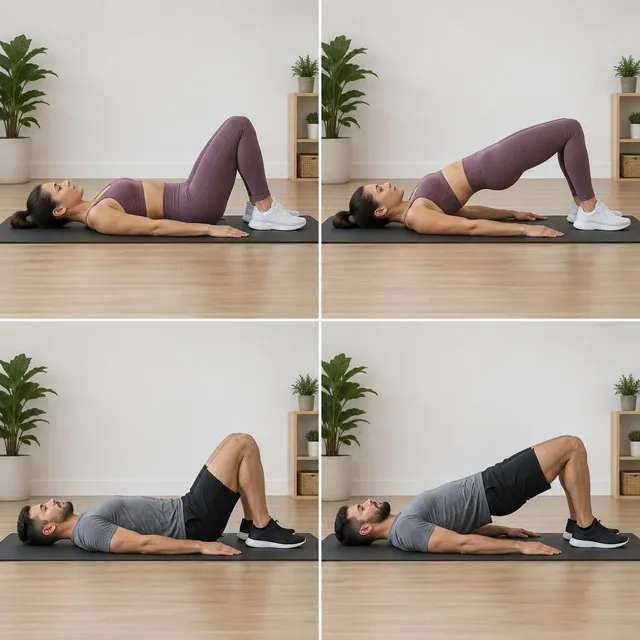
Glute bridge: start and finish position, shown by a woman (top) and a man (bottom)

3.Glute bridge

Works
Glutes, hamstrings, lower back
Beginner dose
3 × 12
  1. Lie on your back, knees bent, feet flat and close to your glutes.
  2. Press your lower back gently into the floor.
  3. Drive through your heels and lift your hips until shoulders, hips and knees line up.
  4. Squeeze your glutes hard at the top, then lower with control.

Too hard? Shorten the range and pause for one second at the top.

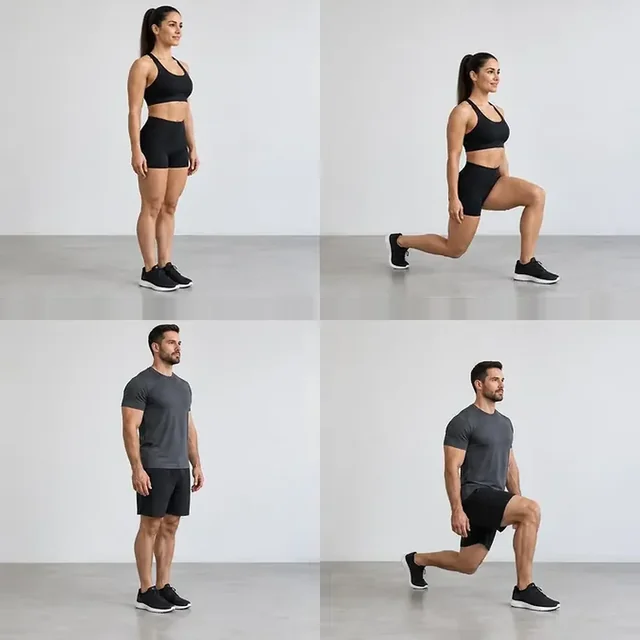
Reverse lunge: start and finish position, shown by a woman (top) and a man (bottom)

4.Reverse lunge

Works
Thighs, glutes, balance
Beginner dose
3 × 8 each leg
  1. Stand tall with feet hip-width apart.
  2. Step one foot straight back and lower the back knee toward the floor.
  3. Keep the front shin vertical and the chest proud.
  4. Push through the front heel to return to standing. Alternate legs.

Too hard? Hold a chair back or wall for balance.

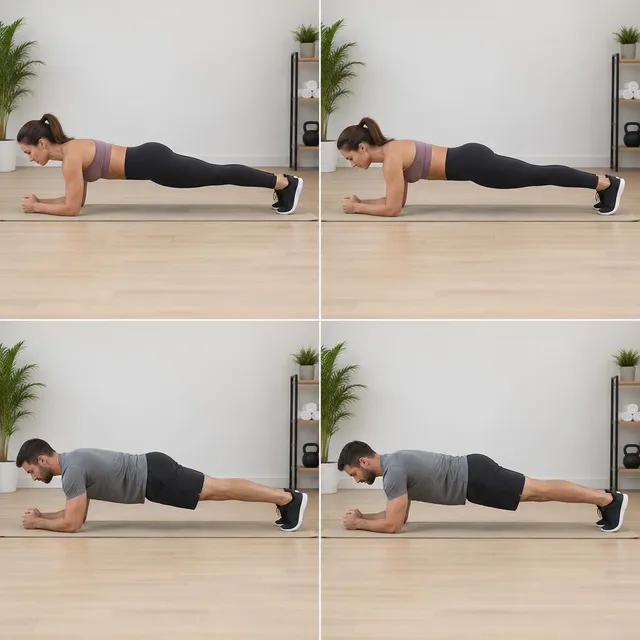
Forearm plank: start and finish position, shown by a woman (top) and a man (bottom)

5.Forearm plank

Works
Abs, shoulders, glutes
Beginner dose
3 × 20 seconds
  1. Set forearms on the floor, elbows under shoulders.
  2. Extend your legs and rise onto your toes.
  3. Squeeze glutes and brace your abs so your body is one straight line.
  4. Breathe steadily and hold — no sagging hips, no piked butt.

Too hard? Drop to your knees and keep a straight line from head to knees.

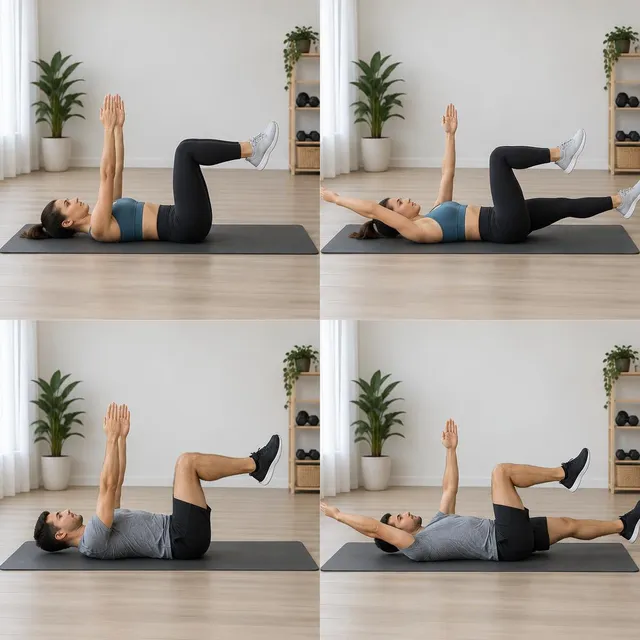
Dead bug: start and finish position, shown by a woman (top) and a man (bottom)

6.Dead bug

Works
Deep abs, lower-back control
Beginner dose
3 × 6 each side
  1. Lie on your back with arms straight up and knees bent to 90°.
  2. Press your lower back into the floor and brace your core.
  3. Slowly lower the opposite arm and leg toward the floor.
  4. Return to start and switch sides, moving with control.

Too hard? Move only the legs and keep the arms pointing at the ceiling.

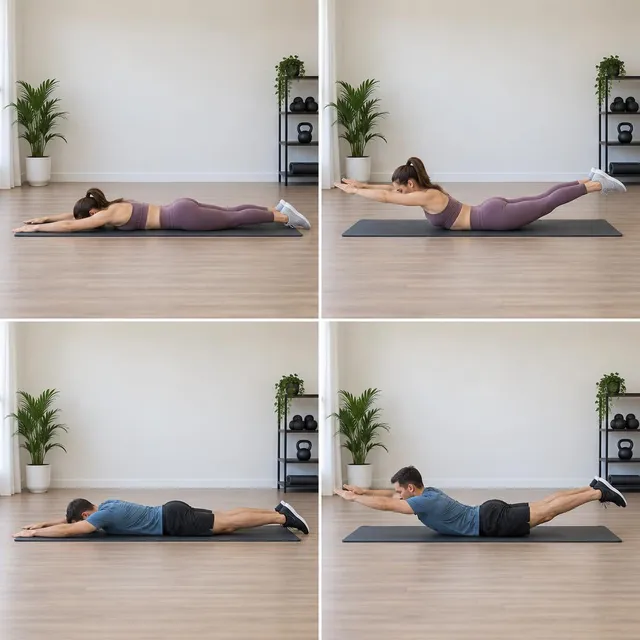
Superman: start and finish position, shown by a woman (top) and a man (bottom)

7.Superman

Works
Lower back, glutes, upper back
Beginner dose
3 × 10
  1. Lie face down with arms extended overhead and legs straight.
  2. Squeeze your glutes and lift your chest, arms and legs off the floor at the same time.
  3. Pause at the top and keep your neck relaxed.
  4. Lower with control and repeat.

Too hard? Lift only the arms, then only the legs.

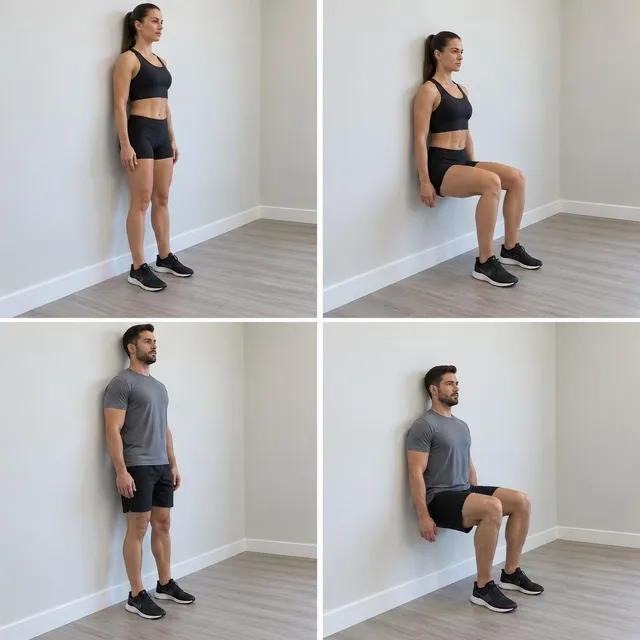
Wall sit: start and finish position, shown by a woman (top) and a man (bottom)

8.Wall sit

Works
Thighs, glutes
Beginner dose
3 × 20 seconds
  1. Stand with your back flat against a wall.
  2. Walk your feet out and slide down until thighs are parallel to the floor.
  3. Knees stay over ankles, not collapsing in.
  4. Press your back into the wall and hold; breathe steadily.

Too hard? Slide down only halfway.

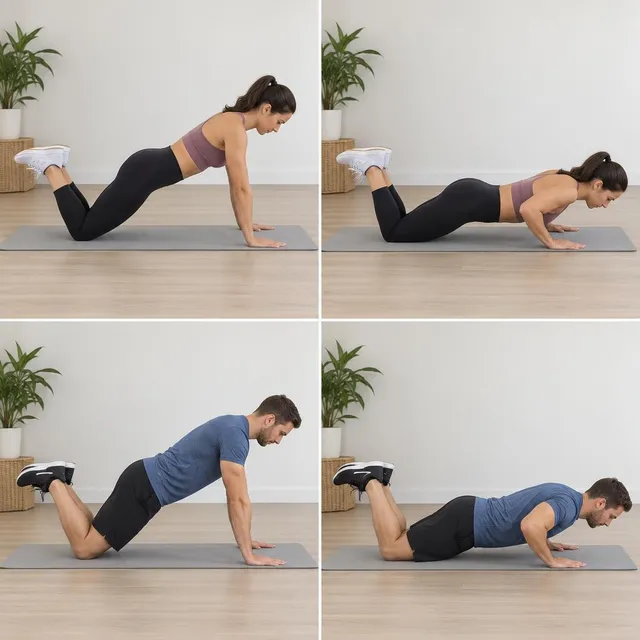
Knee push-up: start and finish position, shown by a woman (top) and a man (bottom)

9.Knee push-up

Works
Chest, shoulders, arms, core
Beginner dose
3 × 6–8
  1. Kneel on the floor and place your hands under your shoulders, a little wider than chest width.
  2. Walk your hands forward until your body makes a straight line from your head to your knees, ankles crossed or feet lifted behind you.
  3. Bend your elbows and lower your chest toward the floor, keeping your hips in line — don't let them sag or pike up.
  4. Press through your palms back to the top and repeat.

Too hard? Go back to the incline chair version until 12 reps feel smooth.

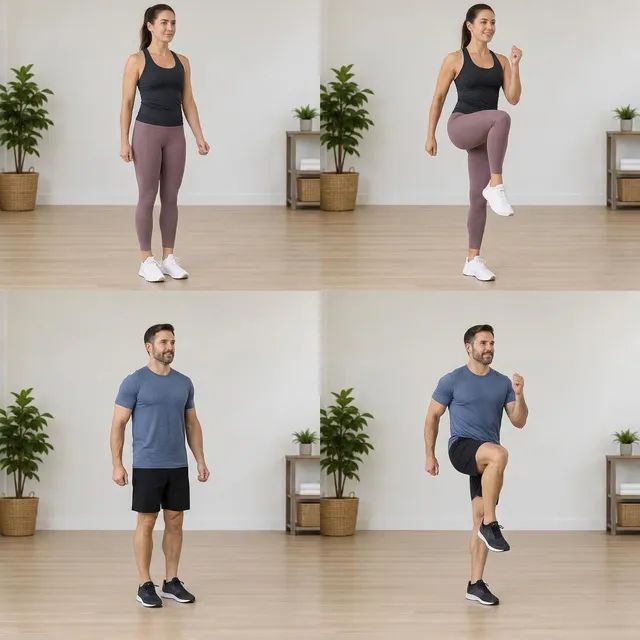
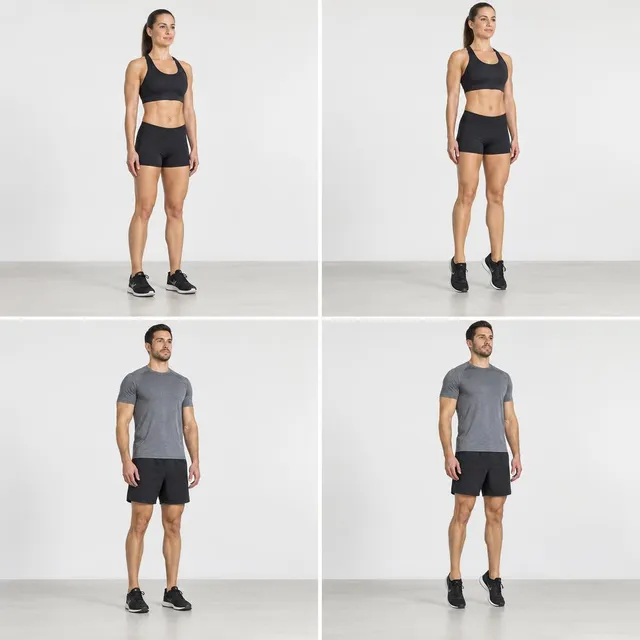
March in place: start and finish position, shown by a woman (top) and a man (bottom)

10.March in place

Works
Heart, hips, legs (low impact)
Beginner dose
2 minutes
  1. Stand tall with a slight bend in the knees.
  2. Drive one knee up toward hip height.
  3. Lower it back down and immediately drive the other knee up.
  4. Pump opposite arms naturally and keep a steady rhythm.

Too hard? Hold a wall and lift the knees lower.

Calf raise: start and finish position, shown by a woman (top) and a man (bottom)

11.Calf raise

Works
Calves, ankles
Beginner dose
3 × 15
  1. Stand tall, feet hip-width apart, core braced.
  2. Press through the balls of your feet to lift your heels as high as possible.
  3. Squeeze your calves at the top.
  4. Lower slowly under control until your heels just touch the floor.

Too hard? Rest your fingertips on a wall for balance.

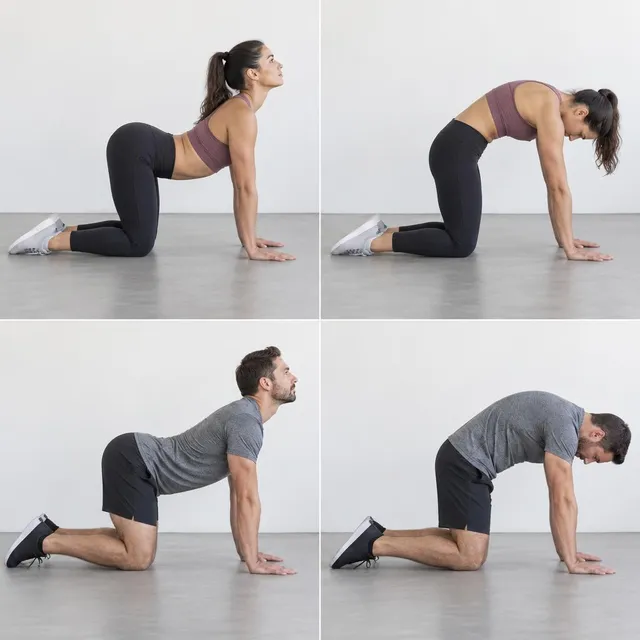
Cat-cow: start and finish position, shown by a woman (top) and a man (bottom)

12.Cat-cow

Works
Spine mobility, breathing
Beginner dose
1 minute
  1. Start on all fours, hands under shoulders, knees under hips.
  2. Inhale: drop your belly, lift your chest and tailbone (cow).
  3. Exhale: round your spine, tuck the chin and tailbone (cat).
  4. Flow slowly between the two, matching breath to movement.

Too hard? Make the movement smaller and slower.

Put them together: a 20-minute beginner session

Warm-up

3 min
  • March in place2 min
  • Cat-cow1 min

Circuit

3 rounds · rest 60s
  • Bodyweight squat10
  • Incline chair push-up8
  • Glute bridge12
  • Reverse lunge8 each leg
  • Forearm plank20 s

Finisher

2 rounds
  • Wall sit20 s
  • Dead bug6 each side
  • Superman10

Three beginner mistakes to skip

  • Going until failure in week one. Stop each set with two reps left. Soreness isn't the goal — coming back on Thursday is.
  • Adding new exercises every week. Add reps instead. Repeating the same moves is how you get stronger.
  • Skipping rest days. Muscles grow between sessions. In Vigorous Home a logged rest day keeps your streak alive.

If you have an injury, a heart condition, are pregnant or haven't exercised in a long time, check with a doctor before you start. Stop any move that causes sharp pain.

Questions people ask

What is the best exercise for a complete beginner?

The glute bridge and the bodyweight squat. Both are easy to learn, gentle on the joints and work the biggest muscles in your body.

How many times a week should a beginner exercise at home?

Two or three full-body sessions a week is plenty to start. After a month you can move to four, with rest or walking days in between.

Can I build muscle with only bodyweight exercises?

Yes, especially as a beginner. Your own body is enough resistance for months; you keep progressing with more reps, slower tempo and harder versions like full push-ups.

How long until I see results?

Most people feel stronger and less out of breath within two to three weeks of steady training. Visible change takes longer and depends a lot on food and sleep.

Want someone to tell you what to do each day?

Vigorous Home turns these moves into guided sessions with a timer, spoken cues and a coach who answers your questions — sized to your level and equipment.

Create my free account

No card today. Premium has a 7-day free trial, then R99/month (about $6).

Keep going